Use of Laboratory Animals in 2024
In 2024, the number of laboratory animals used decreased for the fifth year in a row. The decline of around 9 % compared to the previous year was again substantial.
The German Federal Institute for Risk Assessment (BfRshort forGerman Federal Institute for Risk Assessment) has a statutory mandate to collect data from the German federal states (“Länder”) on an annual basis and then compile this information and forward it to the European Commission.
In addition to the numbers of animals used in experiments, the numbers of animals killed are also reported annually in Germany. The number of animals killed for the purpose of examining their organs and tissues for scientific purposes fell by almost 7 % compared to the previous year. The number of laboratory animals killed that were not used also fell by around 19 %. Both figures are submitted to the European Commission once every five years. The next submission will be in 2028 for the 2027 reporting year.
The BfRshort forGerman Federal Institute for Risk Assessment publishes the collected data, broken down by various topics, in its data report “Laboratory animals used in Germany in 2024 in numbers”, which comprises 48 tables. In addition, the figures, broken down by animal species and purpose of use, are broken down in a separate Download:report for each German federal state (“Land”)versuchstierzahlen-2024-aufgeschluesselt-nach-bundeslaendern-und-bundeswehr-EN.xlsx (XLSX, 260 B, not accessible).
Detailed explanation of the data collected:
Total number of animals used in 2024
In Germany, around 1.33 million vertebrates and cephalopods were used in animal experiments in 2024 in accordance with External Link:section 7(2) of the German Animal Welfare Act (TierSchG). Compared to 2023 (around 1.46 million), the figures have thus fallen by around 9 %. When reporting the laboratory animals used, a distinction is made between those used for the first time and those re-used (see Table 1). First-time use means that the laboratory animals have never been used in an experimental project before and are being reported for the first time. Re-use means that the laboratory animals have already been used in an experimental project and have already been reported. Table 21 of the detailed Download:data reportzahlen-zu-den-im-jahr-2024-verwendeten-versuchstieren-EN.xlsx (XLSX, 417 B, not accessible) breaks down the figures for animals used for the first time and those re-used by animal species.
In addition, Germany goes beyond the requirements of External Link:EU Directive 2010/63/EU on laboratory animals and also records animals that were killed for scientific purposes External Link:(in accordance with Section 4(3) of the Animal Welfare Act) without having undergone any prior procedures or treatments – for example, to use their organs or tissue for scientific purposes (see Table 1). Compared to 2023, this figure has fallen by around 7 %. A detailed breakdown of animals killed for scientific purposes by animal species can be found in Table 47 of the report. The number of animals used in experiments and the number of animals killed for scientific purposes totals around 1.95 million uses of laboratory animals in 2024. Compared to 2023 (around 2.1 million), this is a decrease of around 8.2 %.
Since the 2021 reporting year, Germany has also been recording animals that were bred for animal experiments or for the scientific use of their organs or tissues but were not used for such purposes and were killed (see Table 1). These animals include, for example, offspring from genetically modified lines that do not exhibit the desired modification and were not used for scientific purposes. Laboratory animals that were killed for hygiene monitoring of breeding colonies, for example, also fall into this category. It also includes animals that could not be used for scientific purposes for other reasons, for example because they were too old or did not have the right sex for the experiment.
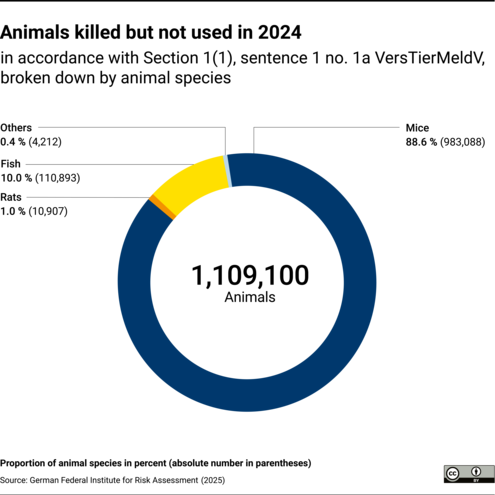
In the 2024 reporting year, around 1.1 million such unused and killed animals were reported. Compared to 2023 (1.37 million), this is a major decrease of around 19 %. A detailed breakdown of unused, killed animals by animal species can be found in Table 48 of Download:the reportzahlen-zu-den-im-jahr-2024-verwendeten-versuchstieren-EN.xlsx (XLSX, 417 B, not accessible). The recording of these figures is due to an amendment toExternal Link: the Laboratory Animal Reporting Ordinance (VersTierMeldV), which came into force in August 2021. In Germany, unused, killed laboratory animals have been reported annually since 2021 and the data has been published by the Bf3R. Since then, the annual number of unused and killed animals has more than halved.
By recording and publishing these figures, Germany is exceeding the requirements of the European Commission, which only requires an EU-wide survey every five years. The European Commission's last publication of this data was in 2024 and contained figures for the 2022 reporting year (External Link:EU report). With its decision to publish these figures annually, Germany is creating greater transparency regarding animal experiments and is thus playing a pioneering role within the EU.
Table 1: Total number of laboratory animals used for scientific purposes, animals killed for scientific purposes and animals killed but not used for scientific purposes in 2023 and 2024
| Purpose | Number 2023 | Number 2024 |
|---|---|---|
| For scientific purposes*, animals used of which | 1,456,562 | 1,327,931 |
| - Animals used for the first-time | 1,424,848 | 1,302,190 |
| - Re-use animals | 31,714 | 25,741 |
| Animals killed for scientific purposes ** | 671,958 | 626,538 |
| Total | 2,128,520 | 1,954,469 |
| Unused, killed animals*** | 1,373,173 | 1,109,100 |
* Animal experiments pursuant to TierSchG section 7(2) of the German Animal Welfare Act (TierSchG)
** Animals killed solely for the purpose of using organs or tissue for scientific purposes (in accordance with Section 4 (3) TierSchG)
*** Animals bred and killed for scientific purposes but not used for such purposes (in accordance with Section 1 (1) sentence 1 no. 1a. VersTierMeldV). The number of these animals was recorded for the first time in the 2021 reporting year as part of the annual laboratory animal report.
Animal species used
Overall, the numbers of animals used in experiments in 2024 have decreased compared to the previous year (Figure 1 and Table 2). However, there were no substantial changes in the percentage distribution of animal species used. Similar to previous years, mice accounted for 72 % and rats for approximately 6 % of the animals used. Fish (zebrafish and other fish species) ranked second among the most frequently used laboratory animals with 13 %, as in the previous year. Rabbits were used in around 4 % of cases, while the proportion of birds (domestic chickens and other bird species) remained low at around 1 % of the laboratory animals used in experiments. The proportion of other laboratory animals also remained at the previous year's level at around 3 %. The exact numbers of laboratory animals for other animal species, broken down by first-time and re-use, can be found in Table 21 of Download:the reportzahlen-zu-den-im-jahr-2024-verwendeten-versuchstieren-EN.xlsx (XLSX, 417 B, not accessible).
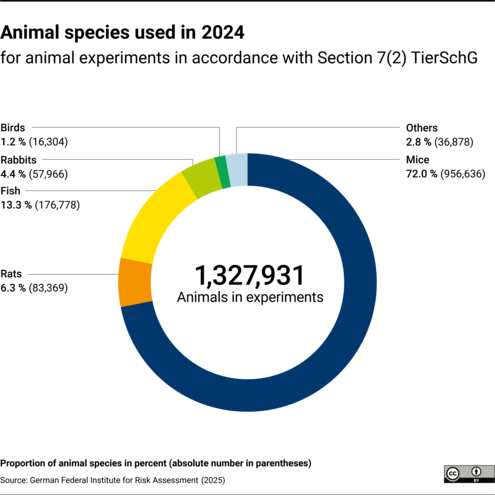
Table 2: Comparison of the numbers and proportions of animals used in experiments pursuant to Section 7(2) TierSchG for the years 2023 and 2024.
| Animal Species | 2023 | 2024 | ||
|---|---|---|---|---|
| Number | Percentage | Number | Percentage | |
| Mice | 1,062,632 | 73.0 % | 956,636 | 72.0 % |
| Rats | 102,731 | 7.1 % | 83,369 | 6.3 % |
| Fish | 161,713 | 11.1 % | 176,778 | 13.3 % |
| Rabbits | 67,524 | 4.6 % | 57,966 | 4.4 % |
| Birds | 20,521 | 1.4 % | 16,304 | 1.2 % |
| Others | 41,441 | 2.8 % | 36,878 | 2.8 % |
| Total numer | 1,456,562 | 100 % | 1,327,931 | 100 % |
Animals killed for scientific purposes (see Figure 2) are mainly mice (87 %) and rats (6 %). Fish (5 %) rank third and birds (around 1 %) fourth. Other animal species, including a large number of clawed frogs, account for less than 1 %. The vast majority (92 %) of kills for scientific purposes are carried out for basic research. The exact breakdown of animals killed in accordance with External Link:TierSchG Section 4 Para. 3 can be found in Tables 47-47.2 of Download:the reportzahlen-zu-den-im-jahr-2024-verwendeten-versuchstieren-EN.xlsx (XLSX, 417 B, not accessible).
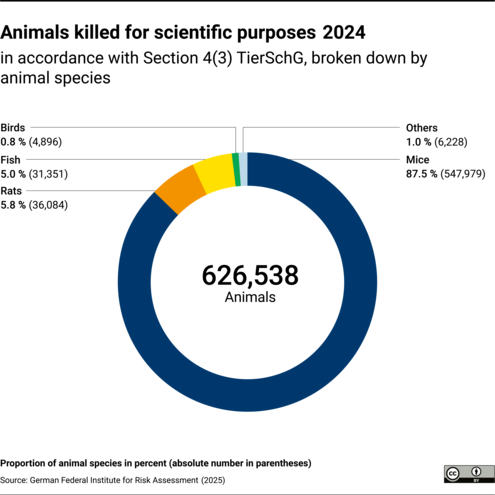
Figure 3 shows the distribution of animal species among animals killed that were bred for scientific purposes but not used for these purposes. Here too, mice are in first place with just under 89 %. Fish are the second largest group with around 10 %, and rats are in third place with 1 %. Other animal species, including birds, clawed frogs and other amphibians, account for less than 1 % in total. The animals killed but not used for scientific purposes were predominantly (around 84 %) genetically modified animals. Since 77 % of the animals themselves were genetically modified, these are likely to be genetically modified (sibling) animals that did not exhibit the changes required for the experiments. The exact breakdown of unused, killed animals can be found in Tables 48–48.2 of Download:the reportzahlen-zu-den-im-jahr-2024-verwendeten-versuchstieren-EN.xlsx (XLSX, 417 B, not accessible).
Development of the figures since 2020
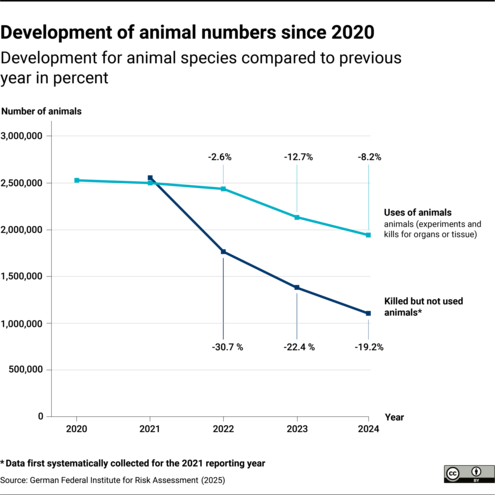
The BfRshort forGerman Federal Institute for Risk Assessment has been collecting and publishing annual laboratory animal figures since the amendment of the Laboratory Animal Reporting Ordinance in 2021. The first reporting year published by the BfRshort forGerman Federal Institute for Risk Assessment was External Link:2020, which was particularly marked by the coronavirus pandemic. Compared to the previous year, the number of animal experiments fell by around 14 % in the 2020 reporting year and the number of animals killed for organs and tissue by around 9 %. Overall, there was a significant decline in the use of laboratory animals of almost 13 %. Since then, the total number of uses has continued to fall, albeit at a slower rate (see Figure 4). It is noteworthy that the decline in the current reporting year 2024 was again significant at around 8 % compared to 2023, even though the previous year 2023 had already seen a very sharp decline of almost 13 % compared to 2022 (see Figure 4).
The number of unused animals killed also fell again in the 2024 reporting year. Although the 19 % decline was less pronounced than in the previous year (around 22 %), it corresponds to a reduction of more than 260,000 laboratory animals killed compared to 2023. Overall, the trend towards a reduction in animal numbers observed since the 2020 reporting year appears to be consistent. The number of laboratory animals used or killed is declining steadily across all fields.
Use of monkeys and prosimians
The number of monkeys and prosimians used in animal experiments fell by 35 % compared to the previous year, reaching a new low of 1,088 uses. The decline even exceeded that of the previous year, 2023, when the number of animal experiments involving monkeys had already fallen sharply. In addition, the proportion of monkeys and prosimians re-used is very high compared to other animal species (around 19 % re-use compared to, for example, around 2 % for mice and around 4 % for rats (see Table 21 in Download:the reportzahlen-zu-den-im-jahr-2024-verwendeten-versuchstieren-EN.xlsx (XLSX, 417 B, not accessible)). The number of monkeys and prosimians recorded for the first time in 2024 is therefore lower than the number of animals reported in experiments (1,088), at 876 animals. Monkeys are used predominantly for regulatory purposes, particularly in the context of authorising new human medicines.
Great apes were last used for scientific purposes in Germany in 1991.
Use of dogs and cats
Dogs and cats are used, among other things, for legally required experiments and applied research. In the 2024 reporting year, 2,220 experiments involving dogs were reported, a decrease of 13 % compared to the previous year (2,550 animals in experiments). In contrast, the number of experiments involving cats rose significantly to 698 animals (2023: 544 animals in experiments). The number of dogs and cats fluctuates comparatively strongly from year to year. However, looking at the last five years, it can be seen that the number of animals used in experiments in 2024 was significantly below the average for the last five years and has thus decreased overall. The number of cats used has remained stable over the past five years. The proportion of animals re-used is very high for dogs and cats, at around 64 % (dogs) and 51 % (cats) (see also Table 21 of Download:the reportzahlen-zu-den-im-jahr-2024-verwendeten-versuchstieren-EN.xlsx (XLSX, 417 B, not accessible)). For this reason, the number of animals recorded for the first time is significantly lower than the number of animals used in experiments. In 2024, 806 dogs and 340 cats that had never been reported before were included in the statistics.
Use of fish (zebrafish and other fish species)
In 2024, 176,778 fish were used in animal experiments in accordance with Section 7(2) of the Animal Protection Act. This represents an increase of around 9 % compared to the previous year (161,713 animals used in experiments). Since the 2019 reporting year, fish have been used increasingly in experiments (347,543 animals in 2019, an increase of 81 % compared to 2018), but since then the numbers have fallen steadily. In the current reporting year 2024, the numbers rose again for the first time but still remained below the level of 2018 (192,040 animals).
Use of genetically modified animals
The absolute number of genetically modified laboratory animals fell by just under 11 % in 2024 compared to the reporting year 2023 (see Table 3). A total of 658,559 genetically modified animals were used in experiments, 79,507 fewer than in the previous year (738,066 animals). The proportion of genetically modified animals in the total number of animals used in experiments was 49.6 % in 2024. This means that in the 2024 reporting year, for the first time since the 2021 reporting year, fewer genetically modified animals were used than non-genetically modified animals. In the previous year, the proportion of genetically modified animals was still 50.6 %. The effects of genetic modifications on animal welfare also changed slightly compared to the previous year; in the 2023 reporting year, approximately 23 % of genetically modified animals exhibited properties that had a negative impact on welfare, while in the 2024 reporting year, this proportion rose to around 25 % of genetic modifications (see Table 3). Mice (85 %) and zebrafish (13 %) were used in particular (for a more detailed distribution, see Table 20 in Download:the reportzahlen-zu-den-im-jahr-2024-verwendeten-versuchstieren-EN.xlsx (XLSX, 417 B, not accessible)).
Table 3: Numbers and proportions of genetically modified and non-genetically modified animals used in experiments in accordance with Section 7(2) of the Animal Welfare Act in 2023 and 2024.
| Genetically modified animals | 2023 | 2024 | ||
|---|---|---|---|---|
| Number | Percentage | Number | Percentage | |
| Not genetically modified | 718,496 | 49.3 % | 669,372 | 50.4 % |
| Genetically modified animals, of which | 738,066 | 50.6% | 658,559 | 49.6 % |
| no pathological phenotype has occured | 601,916 | 41.3 % | 527,661 | 39.7 % |
| pathological phenotype occured | 136,150 | 9.3 % | 130,898 | 9.9 % |
| Total number | 1,456,562 | 100 % | 1,327,931 | 100 % |
Severity of the experiments
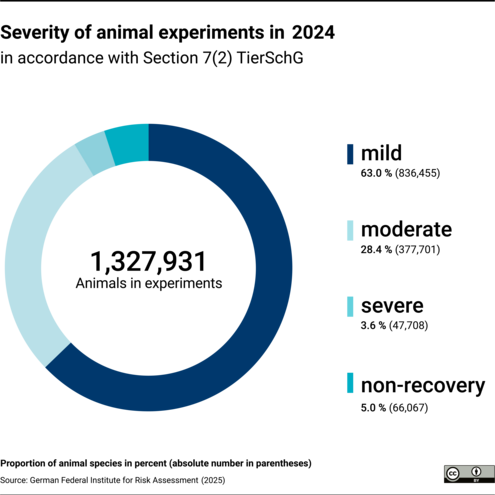
The vast majority of animal experiments carried out in 2024 were classified as low severity (63 % of animals in experiments; Figure 5). This proportion did not change substantially compared to the previous year 2023 (63.8 % in 2023). The proportion of experiments with moderate severity rose only slightly compared to the previous year, to 28.4 %, while the proportion of severe severity remained at the previous year's low level of 3.6 %. As in the previous year, experiments carried out under general anaesthesia from which the animals did not recover (no restoration of vital functions) accounted for around 5 % of uses. Overall, there were no significant changes in the distribution of severity levels compared to the previous year. A detailed list of the levels of severity, broken down by purpose of the experiment and animal species, can be found in Tables 22–34 of Download:the reportzahlen-zu-den-im-jahr-2024-verwendeten-versuchstieren-EN.xlsx (XLSX, 417 B, not accessible).
Scientific testing purposes
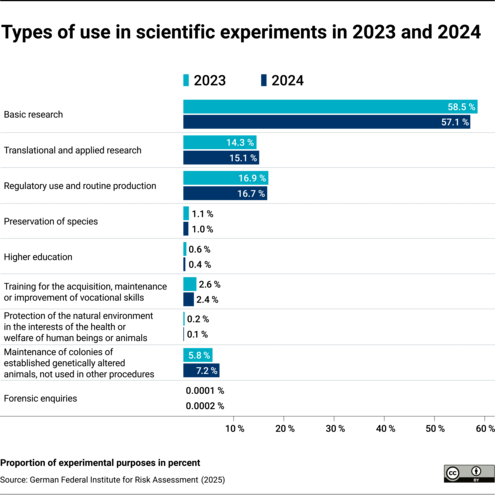
Although many scientific questions can already be answered today through the use of cell cultures, organoids, microphysiological systems, computer-assisted methods and other alternative methods, the use of animals for scientific purposes – including medical research – cannot yet be entirely dispensed with. Around 57 % of animal experiments were used for basic research. Compared to 2023, the proportion of laboratory animals used in basic research decreased by around 2 %. Approximately 15 % of the animals were used in research into human and animal diseases (Figure 6).
Around 17 % of the animals were used for the production and quality control of medical products or for toxicological safety testing. Around 7 % of the animals were needed to maintain colonies of established genetically modified animals and were not used in further experiments. The number of animals reported for this purpose was the only group to increase by around 13 % compared to the 2023 reporting year. However, a decline of around 55 % was recorded for the 2023 reporting year compared to the 2022 reporting year. In a long-term comparison, the number of animals used for the maintenance of genetically modified colonies is therefore also declining.
Other experimental purposes, such as preservation of species, education and training, or protection of the natural environment, accounted for around 4 % of experiments. The number of animals distributed across the individual experimental purposes is shown in detail in Table 9 of Download:the reportzahlen-zu-den-im-jahr-2024-verwendeten-versuchstieren-EN.xlsx (XLSX, 417 B, not accessible).
Animal experiments in basic research
In 2024, research into the immune system (22 %) and the nervous system (20 %) played a particularly important role in basic research. The figures did not change substantially compared to the previous year (see Table 4). Only the field of developmental biology saw stronger growth. The number of laboratory animals used for this purpose increased by around 44 % compared to the External Link:to the previous year. Detailed information, for example on the distribution of animal species for different purposes within basic research, can be found in Download:the reportzahlen-zu-den-im-jahr-2024-verwendeten-versuchstieren-EN.xlsx (XLSX, 417 B, not accessible).
Table 4: Laboratory animals used in basic research in 2024 by purpose of the experiment
| Basic research | 2023 | 2024 | ||
|---|---|---|---|---|
| Experimental purpose | Number | Percentage | Number | Percentage |
| Immune system | 182,721 | 21.4 % | 166,132 | 21.9 % |
| Nervous system | 161,617 | 19.0 % | 148,407 | 19.6 % |
| Oncology | 93,318 | 11.0 % | 88,371 | 11.7 % |
| Cardiovascular system (blood and lymphatic systems) | 102,384 | 12.0 % | 87,738 | 11.6 % |
| Multisystemic | 85,674 | 10.1 % | 52,370 | 6.9 % |
| Endocrine system/metabolism | 52,069 | 6.1 % | 43,381 | 5.7 % |
| Urogenital/reproductive system | 46,932 | 5.5 % | 39,374 | 5.2 % |
| Developmental biology | 26,927 | 3.3 % | 38,834 | 5.1 % |
| Gastrointestinal system, including liver | 34,567 | 4.1 % | 28,600 | 3.8 % |
| Ethology/animal behaviour/animal biology | 19,415 | 2.3 % | 23,582 | 3.1 % |
| Sensory organs (skin, eyes, ears) | 16,679 | 2.0 % | 14,112 | 1.9 % |
| Respiratory system | 13,122 | 1.5 % | 13,705 | 1.8 % |
| Musculoskeletal system | 14,500 | 1.7 % | 12,644 | 1.7 % |
| Other basic research | 2,284 | 0.3 % | 994 | 0.1 % |
| Total number of laboratory animals used in basic research | 852,209 | 100 % | 758,244 | 100 % |
Animal experiments in translational and applied research
As in the Download:previous yearZahlen zu den im Jahr 2022 verwendeten Versuchstieren (XLSX, 130 B, not accessible), applied research into diseases in 2024 focused on the field of human cancers. There was a slight increase in the development of therapies for human neurological and mental disorders (see Table 5). The number of laboratory animals used in research into human urogenital system diseases was less than half compared to the previous year, although the number of such experiments had risen sharply in the previous year. Detailed information, for example on the distribution of animal species for different purposes within translational research, can be found in Download:the reportzahlen-zu-den-im-jahr-2024-verwendeten-versuchstieren-EN.xlsx (XLSX, 417 B, not accessible).
Table 5: Laboratory animals used in translational and applied research in 2023, by experimental purpose.
| Animals in translational and applied research | 2023 | 2024 | ||
|---|---|---|---|---|
| Number | Percentage | Number | Percentage | |
| Human cancer | 81,992 | 39.3 % | 86,823 | 43.4 % |
| Human nervous and mental disorders | 25,367 | 12.2 % | 28,352 | 14.2 % |
| Human infectious disorders | 24,748 | 11.9 % | 21,466 | 10.7 % |
| Human cardiovascular disorders | 11,300 | 5.4 % | 10,773 | 5.4 % |
| Human immune disorders | 13,166 | 6.3 % | 9,609 | 4.8 % |
| Human Endocrine/Metabolism Disorders | 9,275 | 4.4 % | 8,579 | 4.3 % |
| Animal diseases and disorders | 5,906 | 2.8 % | 7,358 | 3.7 % |
| Human respiratory disorders | 6,325 | 3.0 % | 6,687 | 3.3 % |
| Animal welfare | 5,365 | 2.6 % | 4,098 | 2.0 % |
| Non-regulatory toxicology and ecotoxicology | 4,687 | 2.2 % | 3,078 | 1.5 % |
| Human musculoskeletal disorders | 2,786 | 1.3 % | 2,892 | 1.4 % |
| Human Sensory Organ Disorders (skin, eyes and ears) | 2,412 | 1.2 % | 2,699 | 1,3 % |
| Human gastrointestinal disorders, including the liver | 4,656 | 2.2 % | 2,513 | 1.3 % |
| Animal nutrition | 4,643 | 2.2 % | 1,819 | 0.9 % |
| Human urogenital/reproductive disorders | 4,447 | 2.1 % | 1,772 | 0.9 % |
| Diagnosis of disease | 533 | 0.3 % | 886 | 0.4 % |
| Other human disorders | 873 | 0.4 % | 627 | 0.3 % |
| Plant diseases | 53 | 0.0 % | 4 | 0.0 % |
| Total number of laboratory animals used in applied research | 239,885 | 100 % | 200,035 | 100 % |
Review: Animal experiment figures from 2009 to 2020
In 2020, the BfRshort forGerman Federal Institute for Risk Assessment published the data collected from the laboratory animal report for the first time. The annual evaluations can be accessed External Link:here.
A presentation of the use of animals in the reporting years 2009 to 2019 and detailed comparative data can be found on the website of the German Federal Ministry of Agriculture, Food and Regional Identity (BMLEH), which was responsible for publishing the data during this period. External Link:See animal testing data for 2009–2019 here.
Activities to promote the “3R” principle (replacement, reduction, refinement)
The Federal Republic of Germany is striving to reduce the number of animals used in experiments. For this reason, various measures are being taken to replace animal experiments with alternative methods as quickly as possible. These include scientific measures implemented and promoted by the German Centre for the Protection of Laboratory Animals (Bf3R) at the German Federal Institute for Risk Assessment (BfRshort forGerman Federal Institute for Risk Assessment). The measures also include research funding by the Foundation for the Promotion of Research into Alternative and Supplementary Methods to Reduce Animal Experiments (set), various funding measures by the German Federal Ministry of Research, Technology and Space (BMFTR) for the development of alternative methods to animal testing, and the annual awarding of the BMLEH Animal Welfare Research Prize.
Background information on the collection of laboratory animal numbers
On 9 November 2010, the EU Laboratory Animals Directive 2010/63/EU came into force. Its transposition into national law in 2013 also necessitated a revision of the German Laboratory Animal Reporting Ordinance with an extension of the reporting obligation on the use of laboratory animals. Since then, the use of cephalopods (e.g. squid and octopus), vertebrate larvae, and the breeding of genetically modified animals must also be reported. In addition, the severity of pain, suffering or harm (no recovery of vital function, mild, moderate, severe) to which the animals were subjected as a result of their use must also be reported. The use of animals in animal experiments in 2014 was recorded for the first time in accordance with these requirements. On 11 August 2021, the German Laboratory Animal Reporting Ordinance was expanded to require annual reporting of animals bred for scientific purposes but not used for such purposes and instead killed. The number of so-called “unused, killed animals” was recorded for the first time for the 2021 reporting year.
Since 2021, the European Commission has been offering a searchable, freely accessible database on laboratory animal statistics (see Article 54 of the EU Laboratory Animal Directive 2010/63/EU). The External Link:ALURES Database contains statistical data on the annual use of laboratory animals within the European Union. An explanatory video is also available there, providing detailed information on how to use the database.